Sunday, January 18, 2009

Join the Club!

Still subscribed to this old course blog? Nice.

So, I'm trying to start up a school club -- the "Owning Our Ignorance" club -- devoted to fun and logic, in that order. I've put up a blog for it over here.

Check it out. Please join if you're interested.

Real Original, Landis

Thursday, November 29, 2007

Group Presentations: 11:00 AM Class

Here are the group assignments for the 11:00 AM class. If you're not in a group yet, let me know as soon as possible so we can get you in one.

Ethical Relativism (1st on Wednesday, 12/12)
Dana, Kim, Rebecca

Free Will (2nd on Wednesday, 12/12)
David Walker, Ian, Janice, Ralph, Tiffany

Philosophy of Art (3rd on Wednesday, 12/12)
Brittany R., Cara, Daphne, Joe, Stefan

Meaning of Life (1st on Friday, 12/14)
David Wesolowski, Kelli, Sean

Pascal's Wager (2nd on Friday, 12/14)
Kristina, Meredith, Tierney

Philosophy of Mind (3rd on Friday, 12/14)
Brianna, Brittany S., John, Ryan, Victoria

Also, I will be mentioning this in class, but just in case...
Attendance is mandatory for the group presentations on Monday (12/10/07), Wednesday (12/12/07), and Friday (12/14/07). It's the only time I'll be a stickler for it. Basically, I want you to show respect for the other groups presenting.

If you don't attend on either the days your group isn't presenting (and your absence isn't excused), your own personal presentation grade will drop. Each day you don't attend will lower your grade by a full letter grade.
Also, be sure to keep the presentations under 15 minutes. A 10-minute presentation is ideal, so we can have time for a short question-and-answer session afterwards.

Group Presentations: 9:00 AM Class

Here are the group assignments for the 9:00 AM class. If you're not in a group yet, let me know as soon as possible so we can get you in one.

Team Philosophy of Art (Wednesday, 12/12)
Matt, Neah, Stew

Team Meaning of Life (1st on Friday, 12/14)
Brian, Dan, Kyron, Trisha

Team Philosophy of Mind (2nd on Friday, 12/14)
Chris G., Derek, Stefanie, Suzie

Also, I will be mentioning this in class, but just in case...
Attendance is mandatory for the group presentations on Monday (12/10/07), Wednesday (12/12/07), and Friday (12/14/07). It's the only time I'll be a stickler for it. Basically, I want you to show respect for the other groups presenting.

If you don't attend on either the days your group isn't presenting (and your absence isn't excused), your own personal presentation grade will drop. Each day you don't attend will lower your grade by a full letter grade.
Also, be sure to keep the presentations under 15 minutes. A 10-minute presentation is ideal, so we can have time for a short question-and-answer session afterwards.

Wednesday, November 28, 2007

Paper #2 Guideline

Due Date: Monday, December 17th, 2007

Worth: 5% of final grade

Assignment: Write an argumentative essay on one of the topics below. Papers must be typed, and must be between 300-600 words long. Provide a word count on the first page of the paper. (Most programs like Microsoft Word & WordPerfect have automatic word counts.)

1. Compare and contrast two ethical theories we’ve discussed in class. Explain how each theory helps us to figure out what we ought to do when faced with ethical decision making. Focus on specific moral decisions as examples to highlight the differences in the theories. In your opinion, which theory provides a better picture of morality? Be sure to explain and defend your position.

2. Provide a detailed criticism of one of the ethical theories we’ve discussed in class. First, explain the theory, and present a charitable argument (what you take to be the best argument) in its favor. Then critically evaluate the argument. What are good objections to the argument? Consider how a proponent of the theory might respond to your objections, and explain why these responses are unsuccessful.

3. Which do you think is more important in determining whether an action is morally right or wrong: the consequences of the action (what happens as a result of the action), or the motivations behind the action (the reasons why someone chooses that action over other actions)? Why? [NOTE: I’m not looking for one right choice here. You can choose either side, as long as you defend it with a well-reasoned argument.] Explain an ethical theory that we have studied that cares more about the consequences of an action. Then name an ethical theory that we have studied that cares more about the motivations behind actions. In arguing for one side over the other, describe a specific moral dilemma in which these theories would give different decisions based on the action’s consequences vs. its motivations. Be sure to fully explain and defend your position.

4. Within the parameters of ethical theories discussed in class, write on a topic of your choosing. (Sean must approve your topic by December 12th.)

Monday, November 12, 2007

The Great Trashing of 2007

I had a fun weekend:

Saturday, November 10, 2007

Like a Watch, Only More So

Here are some links on the design argument for God's existence. First is a radio interview on Hume's criticisms of the design arg. Second is an article on evolution versus intelligent design.

Third is an article about all the "design flaws" in nature. Fourth is an article on the new research that might show the appendix serves a purpose, and so wouldn't count as a design flaw.

I also have a little music for you. Here's the source of the "more so" phrase:

John Gorka - I'm From New Jersey
"I'm from New Jersey | It's like Ohio | But even more so | Imagine that"


Finally, the National Public Radio show Fresh Air ran a pair of interviews with two scientists talking about whether God exists. The conversations touch on a lot of things we've been discussing in class.

Hey, where's the interview with an agnostic? The media are so biased toward those with opinions.

If you've read a good article on intelligent design, recommend it to us by emailing me or posting the link in the comments section of this post.

Thursday, November 8, 2007

Assignment: Religion Journal

Here is a guideline for the next big assignment: the journal you have to keep during our discussion of God.

Worth:
15% of your overall grade

Due Date: the beginning of class on Monday, November 26, 2007

The assignment is to keep a journal during our section on philosophy of religion. I want you to write several short journal entries about the various arguments for and against the existence of God. We’ll be going over all these arguments in class during the next few weeks. Each entry should be around two paragraphs long.

This assignment is a chance for you to do philosophy. I want you to demonstrate that you understand what we are reading and discussing. (Present each argument in your own words.) In addition to this, I want you to critically evaluate each argument we read and discuss. (Are any premises questionable? Does the argument provide enough support for its conclusion?) It is also a chance for you to give your opinion on these arguments, and defend your opinion with good reasons.

You should have the following journal entries, in this order:
1) Your first entry on your thoughts about God before discussing any of this stuff in class. Do you think there is a God? Why or why not?

2) An entry explaining and evaluating the cosmological argument (Aquinas reading).

3) An entry explaining and evaluating the ontological argument (Anselm & Guanilo readings).

4) An entry explaining and evaluating the design argument (Hume reading).

5) An entry explaining and evaluating the problem of evil argument (Augustine and B.C. Johnson readings).

6) A final entry where you discuss your thoughts about God after reading these philosophers and discussing this in class. Has your opinion about God changed? Have your reasons for your opinion changed?
The journal does not have to be typed. There is no length requirement. (Again, the suggestion is around two paragraphs per journal entry.)

Tuesday, November 6, 2007

Think [Tap-Dance] God

There's a philosophy comic strip that ran a whole series on the ontological argument that god exists. Here are links to the comics:


If you're still jonesing for the a priori, there's also this entry on ontological arguments in the Stanford Encyclopedia of Philosophy.

Finally, here's what Guanilo said to Anselm after he presented Anselm his "Greatest Possible Island" criticism:

you just got served

Monday, October 22, 2007

Past Futures are the New Past Pasts

Do you find yourself obsessed with Hume's question of what could justify inductive reasoning? Boy, do I have a link for you:
Stanford Encyclopedia of Philosophy: The Problem of Induction

If you're tired of that one, there's also a new problem of induction. Or, you could watch this video of Lewis Black describing his failure to reason inductively every year around Halloween:


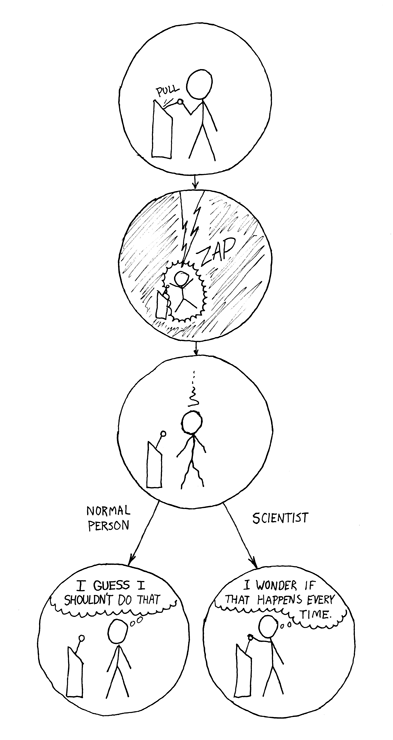
Finally, here's a stick figure comic about scientists' efforts to confirm that the future will be like the past.

Science: Confirming Induction For As Long As It's Been Unjustified

Wednesday, October 17, 2007

Optical Illusions

Julian Beever creates sidewalk art that looks three-dimensional when viewed from a certain angle. Here's one of his creations:
sidewalk illusion art

More pictures of his stuff are available here and here. It's pretty hard to tell that these are two-dimensional drawings. Oh, senses! Why won't you stop deceiving me?!?

ALSO: One response to computer simulation skeptical scenarios like the Matrix is to say that the computer simulation just is our reality. That's what we'd be referring to, after all. When someone stuck in a computer simulation says 'clock,' she's referring to the computer simulation of a clock. Here's an article on that response.

Monday, October 15, 2007

Paper #1

Due Date: Wednesday, October 24th, 2007

Worth: 5% of final grade

Assignment: Write an argumentative essay on one of the topics below. Papers must be typed, and must be between 300-600 words long. Provide a word count on the first page of the paper. (Most programs like Microsoft Word & WordPerfect have automatic word counts.)

1. Criticize skepticism of the external world. Describe what you take to be the best argument for external-world skepticism. Then evaluate this argument. How is this argument unsuccessful? What is/are its flaw(s)? How can we avoid giving in to the skeptic’s arguments that we don’t know anything about the world? [NOTE: For this option, you don’t have to present a positive argument for the existence of the external world. Just explain why the skeptical argument you focus on is bad.]

2. Present and defend an argument for the claim that we can know that there is an external world outside our sense data. Be sure to consider and respond to objections to your argument that a skeptic would likely offer.

3. Defend external-world skepticism. Present an argument for external-world skepticism. Then consider and respond to objections to this argument. Pay special attention to your conception of knowledge: defend the conditions you believe are required for knowledge.

4. Write on an epistemological topic of your choosing. (Sean must approve this topic by Friday, October 19th.)

Tuesday, October 9, 2007

Link-Tested, Keanu-Approved

Now that we've finished going over A Rulebook for Arguments, we're ready to start diving into some philosophical topics in class. This means we're going to start reading some philosophers who are bad writers. Here is a guide to reading philosophy that might help you if you're having trouble understanding the assigned readings.

Our first topic is epistemology (the study of knowledge). Here are some links on knowledge and skepticism. The first is about the philosophical implications of the movie The Matrix.

u just bl3w my mind, dudeThe last link is a more advanced version of the Nick Bostrom article that we're reading for class on the likelihood that we're really in a computer simulation.


By the way, if you have any links you think I or others in class might find interesting, let me know. And feel free to comment on any of these posts.

apparently this cat believes certainty is a requirement for knowledge

Monday, October 8, 2007

Fallacy Comics

Here are some comics and a video about two of the fallacies we've discussed in class. The first is one of Ryan North's Dinosaur Comics on the fallacy of begging the question. (Click on the comic to enlarge it)

DOWN WITH DESCRIPTIVISTS IN THIS ONE PARTICULAR INSTANCE
The next two are Jonathan Ichikawa's comics on hypocrisy and the ad hominem fallacy. (Again, click on the comics to enlarge them)

Hypocrite Hippo
Tofu steaks are bad for statuesFinally, here's the video for Mims's logically delicious song "This is Why I'm Hot":

Wednesday, October 3, 2007

All Mammals are Emo

So maybe all emo kids are lame, but what about emo cats?

the cat writes pretty good poetry, actually

Monday, September 24, 2007

Penguin Digestion Experts? You Bet!

So you didn't believe me when I said that there are experts on the subject of penguin digestion? Oh, you did? Fine, well, I'll prove it to you, anyway. Here are some academic articles on the topic:
Of course, no list would be complete without the often-cited, groundbreaking 1985 Ornis Scandinavica article:
Perhaps my favorite, though, is the following:
If any of these articles are above your head (I think they're all above mine!), you might like this, uh, simpler video demonstration of penguin digestion.

Friday, September 7, 2007

Philosophy as a 3-Year-Old

Here's comedian Louis CK's take on the broad, fundamental questions kids ask (the routine starts with 4:05 left in the video).

Tuesday, September 4, 2007

Email Subscriptions

So why does this course have a blog? Well, why is anything anything?

A blog (short for “web log”) is a website that works like a journal – users write posts that are sorted by date based on when they were written. You can find important course information (like assignments, due dates, reading schedules, etc.) on the blog. I’ll also be updating the blog throughout the semester, posting interesting items related to the stuff we’re currently discussing in class. I used a blog for this course last semester, and it seemed helpful. Hopefully it can benefit our course, too.

Since I’ll be updating the blog a lot throughout the semester, you should check it frequently. There are, however, some convenient ways to do this without simply going to the blog each day. The best way to do this is by getting an email subscription, so any new blog post I write automatically gets emailed to you. (You can also subscribe to the rss feed, if you know what that means.) To get an email subscription:

1. Go to http://cccphilosophy07.blogspot.com.

2. At the main page, enter your email address at the top of the right column (under “EMAIL SUBSCRIPTION: Enter your Email”) and click the "Subscribe me!" button.

3. This will take you to a new page. Follow the directions under #2, where it says “To help stop spam, please type the text here that you see in the image below. Visually impaired or blind users should contact support by email.” Once you type the text, click the "Subscribe me!" button again.

4. You'll then get an email regarding the blog subscription. (Check your spam folder if you haven’t received an email after a day.) You have to confirm your registration. Do so by clicking on the "Click here to activate your account" link in the email you receive.

5. This will bring you to a page that says "Your subscription is confirmed!" Now you're subscribed.

If you are unsure whether you've subscribed, ask me (609-980-8367; slandis@camdencc.edu). I can check who's subscribed and who hasn't.

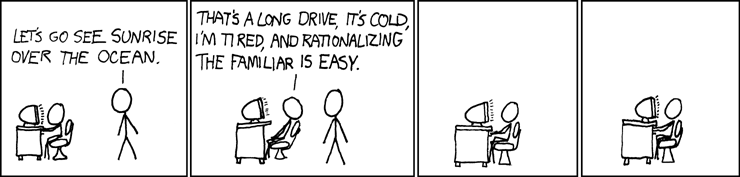
i iz blogginz / leef I alonze

Friday, August 10, 2007

Course Details

Introduction to Philosophy
Camden County College, Blackwood Campus
Philosophy 101, Fall 2007
Section 01: MWF, 9:00 a.m. – 9:50 a.m. in Wilson Hall 201
Section 02: MWF, 11:00 a.m.
11:50 a.m. in Lincoln Hall 019

Instructor: Sean Landis
Email: slandis@camdencc.edu
Phone: 609-980-8367
Course Website: http://cccphilosophy07.blogspot.com

Required Texts
A Rulebook for Arguments, 3rd Edition, Anthony Weston (RA)
Classics of Western Philosophy, 7th Edition, edited by Steven M. Cahn (CWP)

About the Course
This course is designed to introduce students to philosophy. Throughout the semester, we will explore a handful of classic philosophical questions: What is knowledge? Does God exist? Do humans have free will? What does it mean to say that one thing is morally right and another is morally wrong? In examining these issues, it is my hope that we can also develop the skills of doing philosophy—understanding philosophical arguments, evaluating the quality of such arguments, and developing good arguments of our own on philosophical topics.

Grades
90-100% = A; 80-89% = B; 70-79% = C; 60-69% = D; below 60% = F.

Quiz:10%
Midterm: 20%
Final: 25%
2 Papers: 5% each (10% total)
Journal: 15%
Oral Report: 15%
Attendance/Participation: 5%

Exams: There will be a midterm and a final exam. The midterm tests everything covered during the first half of the course, and will last the full period (50 minutes) on the scheduled day. The final exam is cumulative—that is, it tests everything covered throughout the whole course, not just the second half. The final will last 50 minutes, and will take place on the last day of class.

Quiz: There will be a quiz at the end of arguments section of the course. The quiz will last 20 minutes, and be held at the beginning of class on the scheduled day.

Oral Report: The oral report will be a group project presented in front of the class. Each group of 3-4 students will present a 10- to 15-minute presentation toward the end of the semester.

Papers: There will be 2 papers, the first on epistemology, and the second on ethics.

Journal: Each student will keep a journal during our metaphysics section on free will and the existence of God.

Group Work: There will be a lot of group work throughout the semester in which students get together to analyze short articles from newspapers or magazines on the philosophical issues being discusses in class.

Classroom Policies
Academic Integrity: Cheating and Plagiarism will not be tolerated in the class. Students found guilty of either will definitely fail the exam or assignment—and possibly the entire class. (Come to me if you are unsure what constitutes cheating or plagiarism.)

Excused Absenses: Make-up exams, quizzes, in-class projects, and oral reports will only be rescheduled for any excused absences (excused absences include religious observance, official college business, and illness or injury – with a doctor’s note). An unexcused absence on the day of any assignment or test will result in a zero on that assignment or test.

Important Dates
August 31: Last day to drop a course & receive a 100% refund.
September 17: Last day to drop a course & receive a 50% refund.
September 24: Last day to sign up to audit a course.
December 5: Last day to withdrawal from Fall Classes.

Course Schedule

September 5—7: Intro to Class
Wednesday: Check. Check One. Sibilance. Introduction to Class (no reading)
Friday: How to Do Philosophy in 50 Minutes (no reading)

September 10—14: Arguments
Monday: Arguments (RA Chapters 1 and 2)
Wednesday: Types of Arguments (RA Chapters 3-5)
Friday: Types of Arguments (RA 3-5); group work

September 17—21: Arguments
Monday: Deductive Arguments (RA Chapters 6)
Wednesday: Deductive Arguments (RA Chapters 6); group work
Friday: Writing Essays (RA Chapters 7-9)

September 24—28: Arguments
Monday: Writing Essays (RA Chapters 7-9); group work
Wednesday: Fallacies (RA Chapter 10)
Friday: Fallacies & Psychological Impediments (handout); group work

October 1—5: Epistemology
Monday: QUIZ #1; Intro to Epistemology (no reading)
Wednesday: Plato (handout)
Friday: Descartes: Meditations One and Two (CWP 490-496)

October 8—12: Epistemology
Monday: Bostrom: “Do We Live in a Computer Simulation?” (handout); group work
Wednesday: Locke: An Essay Concerning Human Understanding Intro & Chapter 1 (CWP 629-631)
Friday: Hume: An Enquiry Concerning Human Understanding Sections II—IV, Part I (CWP 767-773)

October 15—19: Epistemology/The Existence of God
Monday: Hume (continued); group work
Wednesday: PAPER #1 due; Aquinas: Question 2 in Summa Theologiae (CWP 450-453)
Friday: Aquinas (continued); group work

October 22—26: Existence of God
Monday: Anselm: Chapters 2—5 in Proslogian (CWP 415-416)
Wednesday: Review for Midterm (no reading)
Friday: MIDTERM

October 29—November 2: Existence of God
Monday: Gaunilo’s Reply on Behalf of the Fool (CWP 425-427)
Wednesday: Anselm & Guanilo (no reading); group work
Friday: Hume: Parts II & V in Dialogues Concerning Natural Religion (CWP 862-867; 873-875)

November 5—9: Existence of God/Problem of Evil
Monday: Hume (continued)
Wednesday: Augustine: Books 1, 2, & part of 3 of On Free Choice of the Will (CWP 357-369)
Friday: Augustine (continued); group work

November 12—16: Problem of Evil/Free Will
Monday: B.C. Johnson (handout)
Wednesday: Problem of Evil wrap-up (no reading); group work
Friday: Maimonides: The Guide of the Perplexed (CWP 434-439)

November 19—21: Free Will
Monday: Aristotle: Book III of On the Soul (CWP 223-227)
Wednesday: Hospers (handout)
Friday: THANKSGIVING BREAK (no class!)
carpe diem, lazy bones

November 26—30: Free Will/Ethics
Monday: Journal due; Free Will wrap-up (no reading); group work
Wednesday: Aristotle: Book III, Chapter 1 in Nicomachean Ethics (CWP 275-277)
Friday: Aristotle: All of Book II of Nicomachean Ethics (CWP 269-275)

December 3—7: Ethics
Monday: Mill: Part of Chapter 2 in Utilitarianism (CWP 1060-1063)
Wednesday: Kant: First Section in Grounding for the Metaphysics of Morals (CWP 984-991)
Friday: Ethics wrap up (no new reading)

December 10—14: Ethics/Group Presentations
Monday: PAPER #2 due; preparation for presentations (no reading)
Wednesday: group presentations
Friday: group presentations

December 17—19: Review/Final Exam
Monday: Review for final exam
Wednesday: FINAL EXAM
sup cat